Who Is Mistral Dawn?

Mistral Dawn is a thirty-something gal who has lived on both coasts of the US but somehow never in the middle. She currently resides in the Southeast US with her kitty cats (please spay or neuter! :-)) where she works as a hospital drudge and attends graduate school. Taken By The Huntsman is her first effort at writing fiction and if it is well received she has ideas for several more novels and short-stories in this series. Please feel free to visit her on FaceBook or drop her a line at mistralkdawn@gmail.com

Monday, November 16, 2015

A #Favor. :-)


Hey Everyone!! :-)

There's less than two weeks now until the release of Captivated By The Winter King and I don't know about you, but I'm excited!! :-)  The release date is 11/30/2015 and I've set up a Thunderclap campaign to help me get the word out that day.  I need to get at least a 100 people to support it, or it won't go out, and I would really appreciate it if you wouldn't mind helping me with it.  It's completely free and only takes about 30 seconds.  Just click on the link below, click "support," select a social media platform (Twitter, Facebook, or Tumblr), confirm your support, and that's it!  Thank you so much for your help with this!!!  Also, don't forget to scroll down to see the latest peek at what Kate and Ankou are up to! ;-)


Excerpt:
Blinking, Kate shook her head, "I never expected to meet an actual goddess."

Leaning down, he whispered, "You've been having sex with a former god for a while now."

She stopped and glared up at him. "Are you trying to freak me out?"

Grinning, he shook his head. "No. Just trying to help you put it in perspective."

Laughing, she rolled her eyes. When she focused on him again, she happened to notice a mirror behind him, on the wall of the corridor. Curious, she moved closer. When she saw her reflection she gasped.


Oooooh!!! I wonder what she sees?  You won't have to wait long to find out!! ;-)

How To #Tweet. :-)

Hey Everyone! :-)

I made up a instruction sheet for basic tweeting and someone asked me to put it in a blog post, so here it is! ;-)

Twitter Instructions:
Okay, this is just my take on Twitter, but I thought some of you might find some of these things useful. I've heard a lot of people say they don't know how to use twitter, so I thought I'd tell you my process for composing a tweet. Again, other people may do things differently, and their way may be better. :-)

First, twitter only allows you 140 characters total for each tweet, so every character has to count. Links take up 23 characters (no matter how long they are) and pictures take up 24 characters, so you have to keep that in mind. 

Links: I, personally, think it's essential to include these in any tweet where you want people to go to another website and do something (buy a book, like a page, support a thunderclap, etc). I just don't think people are likely to do anything unless the link is right there ready to click on.


But aesthetically, I think it looks better to use a site like https://bitly.com/shorten/ to shorten your link to something like this: http://amzn.to/1vS2bWs .

Pictures: Some people don't use pictures for a couple of reasons. The most obvious is that they take up a lot of characters. Also, a lot of links will automatically cause a picture to display in the tweet. For example, if you post a link to the Amazon listing of your book, your book cover and the beginning of your description will display in the tweet.

I use pictures in almost all of my tweets. For one thing it makes them standout; I can use teasers with excerpts from my books or reviews of my books in them. And for another thing, it puts them in my "Pictures and Videos" which makes it easy for people who want to retweet me to find my tweets.

This is important, because if you want your tweets retweeted, you have to retweet other people's tweets. That means your twitter page is going to have lots of tweets on it that aren't for your stuff. If people want to retweet you they have to scroll through all of those other tweets to find your tweets...unless you make it easy for them. I also click the little star at the bottom to favorite my tweets, which is another place people might look for my tweets to retweet. Which brings us to...

Pinned tweets: Pinned tweets are tweets that stay at the top of your twitter page. Again, this makes them easy to find and retweet. Also, it marks them out as important to the person who pinned them. If you pin a tweet, it's usually something that you want spread around. It might just be a sales tweet about your books, but it might also be about a sale, event, new release, etc. You can change pinned tweets as often as you like, but you can only have one pinned at a time. I usually change mine once a day. 

Unfortunately, you can only see pinned tweets when you log into twitter on a computer. On mobile apps (at least the one's I've used) the tweets are still there but they aren't pinned, so you have to search for them. Plus, there's nothing to mark them as pinned, so you don't know that they are especially important to the person who pinned them. 

So how can you tell if a tweet is pinned? It says it just like this:


How do you pin a tweet? At the bottom of the tweet are three dots (again this is on a computer, you can't do this from a mobile app):


You click on the three dots and a drop-down menu appears:


This picture says "Unpin" because my tweet is already pinned, but for a tweet that's not already pinned it will say "pin to your profile page." You just click on that and it's pinned. :-) 

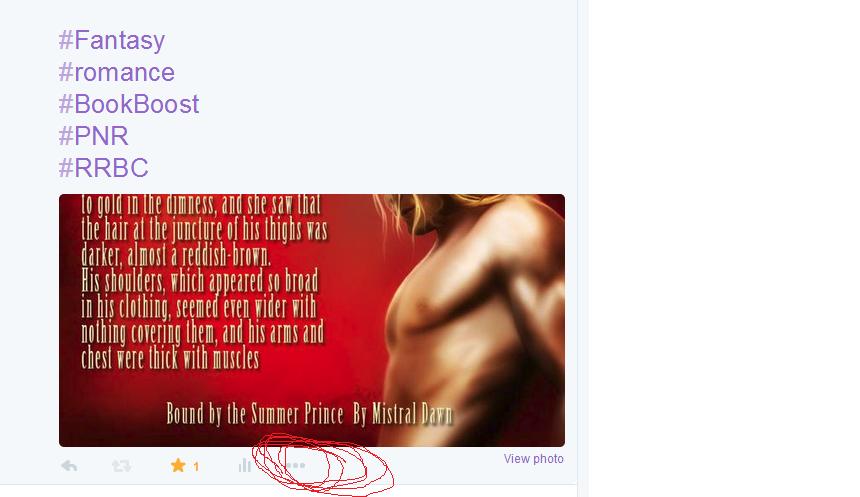
Hashtags: Everyone has heard of hashtags, but not everyone knows what they are. What they are is a way to mark key words. For instance my tweet: 

Let the #Summer #Prince #Heat up your #WeekendReads


#Fantasy
#romance
#BookBoost
#PNR
#RRBC

Notice how the words I want highlighted are marked with hashtags. How do you know which ones to use? Well, it's kind of half guessing, and half logic. You want to use words that people are looking for. It's summertime in the northern hemisphere where many of my readers are, so I have the word "summer" marked with a hashtag. It's part of the title of my book, so it's relevant (never use irrelevant hashtags, that just wastes characters and annoys people), and people who are tweeting about various things to do with summer might look at that hashtag. Even people in the southern hemisphere might look at things with that word, because they're sick of winter and looking forward to summer. So, there's at least a reasonable chance someone might see a tweet with that word hashtagged. Someone looking for a recommendation for a book to read over the weekend might search out #WeekendReads, so I've included that as well. Etc.

Some hashtags are specifically used to request a tweet be retweeted by a group. #BookBoost is an example of that. The twitter ID @freeboostpromo was set up to retweet book related tweets. As always, the best way to get them to retweet your tweets is to follow them and retweet their tweets. Two other hashtags I've found that are usually good about retweeting are #SNRTG (social network retweet group) and #TW4RW (tweets for romance writers), but there are a lot of other ones as well. #IndieBooksBeSeen is a indie authors group that may help with your promotions, but again you have to give if you want to get.

Some hashtags are used to mark genre. In this tweet I've used #fantasy, #romance, and #PNR (paranormal romance) for that, but sometimes I use others. This is to hopefully get your tweet in front of people interested in a specific topic, like fantasy or romance. 

The #RRBC hashtag is for a bookclub I belong to (Rave Reviews Book Club), and I use it to mark me as a member and encourage other members to retweet my tweet. It should only be used by members of the Rave Reviews Book Club, and there are other hashtags like that for other clubs and groups. So it's best to know what your hashtags stand for before using them. Using a hashtag for a group you don't belong to is considered rude, and can upset the people who do belong to that group.

So, back to choosing which hashtags to use. Generally, I try to pick hashtags that a lot of people are using/looking at that day. How can I tell? Well first, there's a list of trending hashtags at the side of your twitter feed (notice I said "feed" and not "page." Also, this is only true on a computer), and that's a good place to start. Your twitter feed looks like this:


As you can see, the Trends list is there on the side. You get to this page by clicking on Home at the top. 

Your twitter page looks like this:


It's where your pinned tweet is and you get there by clicking on your avatar at the top and then on "view profile." You get to other people's twitter pages (to find their pinned tweets and pictures to retweet) by clicking on their twitter handle in one of their tweets, or by searching for their twitter handle and clicking on their page from there. The list of trending tweets will also show up on your twitter page, but you can't tweet from that page as easily (you can, it's just an extra step), so back to your twitter feed. If none of the hashtags that are trending seem relevant, then you can look for ones that do. You can put a hashtag in front of any word you want to mark, there aren't any restrictions on this other than that it should be relevant to keep from annoying people, but you usually want to pick words that people are looking at/using (unless you're trying to create a new hashtag in the hope it will become popular like #author4author). So how do you figure this out? One way is to type in a word with a hashtag in front of it, and see if Twitter has any suggestions for you. Like this:


You see when the cursor is on "summer" Twitter creates a drop down box with suggestions. These are usually hashtags that are being used/searched. As you type your word in, see if Twitter gives you any suggestions. In this case, "summer" is on the list, so I've used it. You can check each of your hashtags this way, to try to gauge the chance of it helping get your tweet seen.

How do you attach pictures? Well, the easiest way is just to click on the "add photo" button and select the picture you want to attach from your picture files.


But sometimes you want to be able to cut and paste a whole tweet, including the picture. For that you need the picture twitter link. The easiest way I've found to get that is this:

1. Tweet the tweet with the picture attached using the "add photo" button.

2. Find tweet after it's been tweeted and click on the three dots on the bottom and then on the 'delete tweet' button on the drop-down menu:


3. When you do that, a new box will appear with the whole tweet, including the picture link. You can select (by dragging your cursor along it) and copy (by right clicking) the picture link from here. **Be careful to make sure you hit the 'cancel' button and not the 'delete' button when you're done copying your picture link:


4. Then you just put the tweet all together and it's ready to tweet:

Let the #Summer #Prince #Heat up your #WeekendReads

http://amzn.to/1aGXdFJ 

#Fantasy
#romance
#BookBoost
#PNR
#RRBC
pic.twitter.com/XnZWz8ZtMp


This is useful if you want to give someone else tweets for them to tweet for you (like a street team) or if you want to use an automated tweet feed (like feed140) and include pictures in your automated tweets.

Anyway, this is how I make my tweets. One thing I can't stress enough is that if you want your tweets to be retweeted, retweet other peoples' tweets. If someone retweets you, don't just send a tweet saying thank you, retweet something of theirs. And try to make sure what you retweet is actually something of theirs and not something they've retweeted for someone else. If they haven't made it easy for you with a pinned tweet or pictures, try looking at their profile and see if you can figure out what's important to them (are they selling something? Do they have a blog? etc.). Also, look for tweets that have been created by their twitter ID, and not tweets that say "retweeted" in them. Thanks are nice, but retweets are better. ;-) Hope this helps! :-)


Sunday, November 15, 2015

#Laugh & The Whole #World #Laughs With You...


Hey Everyone!! :-)

Here's the next installment of An Animal Rescuer's Guide To Staying (Relatively) Sane.  In this section I talk about the need for a sense of humor.  Animals are awesome at getting themselves into predicaments.  They also aren't shy about making their displeasure known through less than polite means.  All of this means you have to be able to laugh or you'll go crazy.

The kitty above, Saeatae, was protesting the fact that his favorite cat bed was in the wash at that time.  You can't see it in the picture, but to make his point he very kindly knocked over the recyclable-metal bucket and spread the contents around my apartment.  Here, he's in the process of shredding the recyclable paper, presumably, with the same goal in mind.

Some Things You Need To Come To Terms With And/Or Remember Continued:
6. Keep your sense of humor. A sense of humor is essential for anyone who wants to work with animals. Many animals have sensory systems (vision, hearing, etc.) that are very different from those of humans. Couple this with the differences between humans and many other animals in how these stimuli are processed in the brain and reacted upon, and you have a recipe for some truly hilarious situations. Of course, without your sense of humor these same situations become annoying and frustrating. Given a choice, how would you like to spend the bulk of your time?  Amused? Or frustrated and annoyed? See why a sense of humor is so important? Also, after days and months and years of dealing with people and their stupidity, irresponsibility, cruelty, and ignorance, you can either learn to find the humor in a situation or you can end up in a padded room tended by the people in white coats. There really is no other option. One caveat: the most important person to learn to laugh at is yourself.


Saturday, November 14, 2015

The #Journey


Hey Everyone!! :-)
Happy Saturday!! :-)  I've got a big test I'm taking today, so wish me luck!! :-)  My friend Kate is helping me out by taking over today.  She's got some thoughts about how we all travel through life.  Take it away, Kate! :-)

Kate:
It was a day. I remember that. All day he'd been amped and huffy. He didn't talk, well, no more than two words or so and he didn't always respond to what you said with any indication he'd understood although other times it was clear he understood perfectly. Most of the day I'd spent soothing his ruffled little self down and telling him that it was going to be okay. This continued through thrown toys, hitting the walls, bashing the cabinets and tossing his chips. Part of me wanted to yell or scream or be done, but mostly I was used to this. As the day wore on, he seemed to become increasingly agitated, which is not all that common with my job. Generally, if someone starts the day agitated either there is a reason you can find to help them (something hurts etc) or they just calm down on their own as the day wears on and there is nothing that continues to upset them. We all wake up cranky sometimes. That day though, he finally came at me. Grabbing, yanking at my hair, trying to fasten his hands around my throat to strangle me. At that point, I raised my voice for the first time that day and with a gesture of my hand I pointed at the sofa where he sometimes had to be restrained. All I said was " You are FINISHED. You will SIT DOWN AND BE NICE! RIGHT NOW."

The other staff with me had been shadowing me all day and they seemed absolutely amazed that I raised my voice. The order worked and he sat, glaring at me and playing with his toys quietly. He really was done and he did not make another attempt to harm anyone although I am sure he was thinking about it. The staff working with me said:

"I didn't think you ever got upset with them. You've been calm all day."

And I felt very odd in that moment, not knowing exactly how to explain. I finally decided I would at least try even though I was not at all sure what I was thinking made sense to anyone but me and them.

"There are lines they don't get to cross with impunity in this house or with me. He hadn't crossed any of those lines."

The staff gaped at me: "He threw his toys, he broke a bowl, he screamed and yelled, how is that not crossing into unacceptable."

I said: "Because you don't know him. Those are unacceptable and inappropriate things for others. He's not there yet. He and I? We're still working on not hitting people. That's where we're at. It's great to have goals but really, this is where we're at right now and that's okay."

My co-worker looked confused and stared at the man sitting on the sofa: "Well everyone else is always telling him what to do and what not to do and micro-managing him."

And I replied "And everyone else is always getting hit. And rightly so. Consider this. You and I go on a walk. I tell you that we are going on a walk and I invite you to start at this house. So you show up and I'm not here. You look around, you wait, you try calling my phone and I don't answer. So eventually you decide to just start walking and sure enough, you eventually find me at the end of the walk with a bunch of other people. I've been sitting there the entire time talking with them about how difficult it is to take a walk with you and how you can't be depended upon to even manage the simplest tasks without showing up late. When you ask why I didn't walk with you I just stare at you and tell you that it's because I don't need to take that journey. I'm already here. Would you walk with me again?"
The answer of course, was "No." It seems so simple when you look at it like that but so frequently when in the midst of one crises after another, one more step towards some distant goal, one more change in plans or ideas we lose sight of the fact that we are on a journey. This journey involves others, not just you. And when you decide to walk with someone, you need to start where they are at. You don't stand at the eventual end of the walk and yell at them because they aren't there yet, you start at the beginning and encourage them every step of the way. This is life. Start where you are at and honor those that start in a different place. There is strength in the journey and it is worth taking simply for having said you walked with a friend.


Friday, November 13, 2015

#Everybody Has Their #Reasons


Hey Everyone!! :-)

I thought this quote from Shakespeare was appropriate for today's installment of An Animal Rescuer's Guide To Staying (Relatively) Sane.  Working with animals also, usually, means working with the public, to one extent or another.  As anyone who has ever worked in retail or food service knows, it's amazing what kinds of personal questions complete strangers feel they have the right to demand answers to.  This segment is about the question I've been asked most often as an animal rescuer and how I generally respond.

Some Things You Need To Come To Terms With And/Or Remember Continued:
5. People are going to ask you why you choose to work with animals. There is a common opinion in our society that human animals are more important than non-human animals. You may or may not share this opinion, but, regardless, you are going to be asked this question. People are going to ask why, when there is so much human suffering, you choose to devote your energy animals. You may or may not be comfortable sharing your reasons, and if you are great, go ahead. However if you aren’t you may want to do more than just change the subject or turn the question back on the asker. For the most part, I’m not big on explaining myself. A person’s motivations are generally nobody else’s business. However, when I’m asked this question I look on it as an opportunity to try to get the asker to think. I usually respond by asking the person why they think human suffering is more important than animal suffering. Or if they think animals do not feel pain in the same way humans do. Or if they believe humans bear a responsibility towards domesticated animals, since we have changed them to reflect our desires rather than what would enable them to survive without our help. These questions are not asked to start an argument (and if you aren’t comfortable doing this, don’t), but to provoke thought. If someone becomes belligerent I usually just say something to the effect "Well, if that issue is so important to you, then by all means go ahead and work for it. We all have causes that are near and dear to our hearts and I have chosen mine." This will usually diffuse an argument, if one starts to form. Regardless of what response you choose to make, you will be asked this question and you have no reason to feel guilty for your choice. At least you are working for something. So many people work for nothing at all beyond their own betterment.


Thursday, November 12, 2015

#Interview With Megan Bailey!! :-)


Hey Everyone!! :-)

Megan Bailey is joining us today.  Megan, can you tell us about yourself and how many books you have written?

Megan:  Hi! I'm a thirty-something author from Illinois. I like to write New Adult, Romance, and Paranormal stories with quirky characters. My first novel, There Are No Vampires In This Book, was released on June 2nd of this year.

Me:  Congratulations!!! :-)  What inspired your story?

Megan:   There Are No Vampires In This Book was inspired by some supporting characters in a short story I wrote ages ago. I loved them and felt like they needed their own story. It changed and grew into something I hadn't expected.

Me:  Cool! :-)  What are you working on now?

Megan:  I'm working on a part 2 for TANVITB, from Aiden's perspective. I've also been working a little bit on a paranormal story that's full of angels, demons and all sorts of chaos.

Me:  Sounds great!  What are you reading now?

Megan:  Finding Forever by Linda Oaks and The Treemakers by Christian L. Rozelle.

Me:  A twofer! ;-)  For those who might consider reading your book, what would you tell them to expect?

Megan:  Taryn deals with some darkness, but she has some amazing friends at her side. Be prepared for some sarcasm and shenanigans.

Me:  Sounds like fun! :-)  What is your favorite part of being an author?

Megan:  Hearing someone else talk about one of my characters as if they were real.  I spend so much time with these characters in my head. When someone tells me they connected with them, too, it's pretty exciting.

Me:  Yeah, it's an amazing feeling when you find out others like your work. :-)  Do you have a day job as well?

Megan:  I help maintain and order inventory at a warehouse. It isn't exciting in the least, but I do get to squeeze in a little writing on breaks.

Me:  Hey, whatever pays the bills. ;-)  What are the hardest and easiest parts about being a writer?

Megan:  For me, the easiest part is coming up with ideas. I see all sorts of little things that spark my imagination and make me wonder "what if?". The hardest part is writing those ideas out. There are so many distractions, time killers, and things to discourage you from writing. Keeping your butt in the seat and your fingers on the keys can be a challenge.

Me:  I hear you there.  What genre do you place your book in?

Megan:  New Adult, Contemporary

Me:  Great!  Is there anything else you'd like to tell your readers?

Megan:  THANK YOU. Thank you so much for checking out my book. Hugs to everyone who has left a review or told a friend. It means the world to me.

Me:  Yes, definitely thank you to all those who read our books!! :-)  Are there any links you'd like me to post?


Me:  Awesome!  Thank you for dropping by today, Megan.  And thank you everyone else who joined us!! I hope you enjoyed the interview, and don't forget to stay tuned for the next installment of Mistral Dawn's Musing! :-)


Wednesday, November 11, 2015

#Coping #Strategies & #Survival


Hey Everyone!! :-)

Today's excerpt from An Animal Rescuer's Guide To Staying (Relatively) Sane is kind of long.  And I've already written quite a bit on this blog about how important it is to be kind to yourself and take care of your own emotional well-being, so I'm going to keep this short.  The picture above is Squeaky and he's cuddling his own security-object, a stuffed purple lamb. :-)

Some Things You Need To Come To Terms With And/Or Remember Continued:
4. While doing rescue you will see people at their best and you will see people at their worst. You will see cruelty that will break your heart and turn your stomach, and you will witness acts of self-sacrifice and love that will take your breath away. You need to learn to reign in your feelings without squashing them. The day you stop feeling for the animals that you are helping, is the day you need to give up rescue. But at the same time, you can’t take an ax to people who are dumping off their pet; even if they are the tenth person that day to do so. You need to find a way to deal with the ups and downs that are a part of rescuing. If that means crying, cry. If that means screaming, scream. If that means writing long winded manuals on how to do rescue, then do that. Whatever works for you, do it. Just try to make sure you do it at the appropriate time. Some things that I've found effective or that I've heard mentioned by other rescue workers include the following.

Take time out for yourself. Whatever it is that you like to do and that helps you relax, make sure you set time aside for it. This may be taking a bath, reading a novel, watching a movie, having coffee with friends, etc. Whatever it is, do it. Don’t feel guilty for taking care of yourself, if you’re not okay, none of the animals in your custody will be okay. It is really important to try to establish some balance in your life, and that needs to include personal time and space. If you make your entire life about animal rescue, you will burn out quickly. Have a time that is set aside for just you, and don’t let anything (within reason, of course. It’s hard to ignore a tornado, etc.) interfere with your time. I’m serious, this really needs to be a part of your schedule. If you figure you will just take time when you find it, you will never find it. Also, have some space set aside in your home for just you, with no animals (or maybe just your personal pets, no rescues). This space doesn’t need to be large, a bedroom or a bathroom will do, but it does need to be inviolate. It is not space that you can use to take in another "emergency" rescue (this is where being able to say no can become a challenge, but you have to do it), it is space that is set aside for YOU. Period.

Learn to recognize a lost cause. This can very occasionally refer to an animal. Sometimes you just have to let them go because there is nothing else to be done, though I have at times seen true miracles pulled out of a hat, and everything you can do will just prolong their suffering. A good indication of when you have reached this point is when more than one vet whose opinions you trust has told you that not only is there nothing more that can be done, but that the animal is in pain. At this point, there is nothing you can do beyond extending the kindness of ending their pain. No matter how difficult and painful this may be for you, it is the best thing for the animal. However, this more often applies to people. There are some people who you are just not going to be able to convince. No matter how much you talk to them, how well-reasoned your arguments are, how much evidence you show them, they are going to continue to be irresponsible and/or cruel. Arguing with these people will accomplish nothing beyond frustrating you. Sometimes there are steps you can take within the legal system to check these people’s activities. Sometimes this is a good idea, but sometimes it just makes the situation worse. The legal system is far from perfect when it comes to exacting justice for humans. The laws pertaining to animals are often worse than a joke. It’s not fair, but it is reality. It’s one of the things we are working to change. Sometimes, as hard as it may be, as unfair and insufficient as it may seem, as much of a problem as it may cause, you just have to let it go. Letting go is one of the hardest lessons you will learn as a rescuer. But if you dwell on these situations you will drive yourself mad. Remember item number 1: You are human. You don’t control everything and you have a finite amount of energy. That doesn’t mean you give up the fight entirely; you just have to learn to pick your battles.

Unplug the phone. Your phone, whether it be a cell phone or a land line, is there for your convenience, not that of others. If you are not in the frame of mind or mood to talk to someone, don’t. It’s that simple. If it is important, they can leave a message or call back. You are under no obligation to pick up the phone if you don’t want to. The world will not end if you are out of range of communication for a while. And don’t feel as though you need to make excuses either. It’s nobody’s business why you didn’t answer. If someone is rude and obnoxious enough to ask you why you didn’t pick up, try asking, “why do you ask?” If they persist change the subject. Some of these obnoxious people will play the ‘I’m going to call you every three seconds until you pick up’ game. That is why I said unplug the phone (or turn it off). Don’t let anyone bully or guilt you into doing something you don’t want to do. You are doing this work out of the goodness of your heart, so you don’t owe anybody anything. This goes for email too.

This is not a comprehensive list of coping strategies, but it is a good place to start. If you have any things that have worked particularly well for you, please feel free to add them. This guide is meant to be a continuously evolving work, so please feel free to change it as needed.